Facebook Blogging

Edward Hugh has a lively and enjoyable Facebook community where he publishes frequent breaking news economics links and short updates. If you would like to receive these updates on a regular basis and join the debate please invite Edward as a friend by clicking the Facebook link at the top of the right sidebar.

Thursday, January 29, 2009

Poland's Economy Contracts In Q4 2008

Poland is probably sliding into a “technical recession” as the slowdown in its biggest trading partners batters the economy in the largest of the European Union’s eastern members, Citigroup Inc. said.

Poland’s economy probably contracted as much as 0.2 percent in the fourth quarter from the prior three months and will shrink about 0.5 percent this quarter, according to Citigroup’s Warsaw-based economist Piotr Kalisz. The slump may mean the government risks missing its budget-deficit goal of less than 3 percent of gross domestic product, he said.


“The slowdown could be a surprise to the government, which still counts on almost 2 percent economic growth,” Kalisz said. “The Polish government could be forced to revise the budget in mid-2009 and raise the deficit ceiling. However, the government prefers to stick to fiscal discipline rather than fiscal stimulus,” limiting the size of the revision, he added.


Poland’s central bank lowered its key interest rate by three-quarters of a percentage point as slowing economic growth forces companies to cut investments and employment, capping inflation. The Narodowy Bank Polski lowered the seven-day reference rate to 4.25 percent.

“The recent macroeconomic data justify such a scale of reduction as a reaction
to slowing economic growth and waning inflationary pressure,” said Jaroslaw
Janecki, chief economist at Societe Generale in Warsaw. “We expect the end of
the easing cycle in May or June, with the key interest rate at 3.5 percent.”


Barlinek SA, Poland’s largest maker of wooden floors, fell in Warsaw trading after a decline in the zloty caused losses on its hedging transactions.

Barlinek declined 0.06 zloty, or 3.8 percent, to 1.52 zloty, after earlier declining to a record low. The WIG Index rose 0.9 percent.

Kielce, southeast Poland-based Barlinek said its loss on currency deals that will be settled in 2009 and 2010 stood at 51.3 million zloty ($15.6 million) as of Dec. 31. The company recorded a profit of 10.4 million zloty on currency contracts settled in 2008, it said in a regulatory statement yesterday.

Echo Investment SA, a real-estate developer also controlled by investor Michal Solowow and based in Kielce, gained 0.05 zloty, or 2.6 percent, to 1.96, rising for the second time this week and recovering from a 10 percent drop.

Echo had a total loss of 238.6 million zloty on zloty contracts last year, it said in a regulatory statement yesterday. Net income for the year will be at least 100 million zloty because the company increased the value of property on its balance sheet.

“The information” from Echo “is positive for investors, since until now it wasn’t known what type of hedging the company had,” Maciej Wewiorski, an analyst at Dom Maklerski IDMSA, said by phone today. “It’s apparent that the company didn’t speculate on currency moves,” he said, adding that the hedging strategy was “very clear” and it “worked as it should.”

Cersanit SA, Poland’s largest producer of bathroom fittings, also controlled by Solowow, fell 0.3 percent to 9.75 zloty after falling 6 percent yesterday.

The company’s loss on outstanding currency contracts stood at 52.9 million zloty at the end of 2008 and it recorded an 11.7 million-zloty loss on deals settled last year, it said in a regulatory statement after the close of trading yesterday.


Wednesday, January 21, 2009

The Forex Lending Crunch Means Trouble Is Looming Large In Poland

Poland now looks set to become the latest shoe to drop in the ongoing crisis which is steadily extending its reach from one country top another, right across the whole of Central and Eastern Europe - the latest and possibly the last in the sense that if Poland does role belly side up this will probably be the one which finally does turn the apple cart well and truly over.


Italy's UniCredit, the biggest lender in emerging Europe, said on Wednesday there was a clear risk of the global credit crunch gripping the region and it was up to international banks to help to avert it. UniCredit board member Erich Hampel said in a presentation at the Euromoney conference in Vienna that the bank was committed to fund its subsidiaries in those countries and would continue to lend to consumers and companies. It called on other banks active in the region, the European Union, the International Monetary Fund, other institutions and the countries concerned to launch a joint plan to stem the threat that funds could stop flowing and choke economic growth. "The international financial crisis is questioning future developments and the risk of a credit crunch is clear," said Hampel, who steers most of UniCredit's emerging European units as head of its Bank Austria arm. "A number of interested parties are involved and the support to the region should come from all of them together," Hampel said. "Coordination is essential and a 'Plan for CEE' should be designed."


Eastern Europe is - as Unicredit's Eric Hempel argues in the extended quote above - quite simply falling headlong into a very severe credit crunch, as funding for bank lending steadily dries up. And, unfortunately, as the evidence mounts that Poland is caught in the teeth of this crunch, its real economy falls deeper and deeper into the dreaded pit with each passing day. FT Alphaville's Izabella Kaminska has the forex loan story here (see also see here last Friday). Basically all I have to add are some charts (and some real economy analysis) to add a bit more weight to the point and illustrate more explicitly the speed with which things are now moving forward.

How Important Are Forex Loans In Poland?

Poland’s exposure as to foreign-currency lending has already been extensively documented and analysed on this blog, but just in case there is still anyone out there who holds defiantly onto the view that the extent of such lending in Poland is simply too small and too recent to have any sort of severe impact on the economy, let's take a look at the recent progress in such lending, at least as far as household behaviour goes. As can be seen in the first chart below, since the middle of 2007, the rate of growth in zloty loans has slumped steadily, while forex borrowing has gone up and up, until..... until last November, when the whole thing turned. It now pretty clear that something quite important happened to the Polish banking system back in October - as I attempted to analyse in this post which was written at the time.


The extent of the transition can also be seen from the monthly chart for outstanding household loans, where again zloty loans can be seen to have have virtually stagnated, while forex ones went shooting up and up, till they seem to have hit a something akin to a "dead stop". Nor does the loan "revaluation" argument help us here, since during the period under consideration the zloty has been falling (see chart below) and hence the book value of the capital stock of forex loans should rise, not fall. (I mean, unfortunately, and from a large number of comments I have received on my blogs over the last 18 months, I have to say that this is the part of the story that many of those who have taken out unhedged forex loans in Eastern Europe simply do not "get", it isn't so much the payment stream you need to look at (influenced by the relative interest rates in the two currencies being compared) but at what happens to the capital value - that is what happens to the outstanding sum you owe, as measured in your own local currency, or at least in the currency in which you are paid.


And for those who are interested in how domestic monetary policy works these days (ie how effective central bank interest rate policy is at containing lending in a small or medium sized open economy with access to global finance) it should not come as a surprise to find in the chart below that the uptick in enthusiasm for forex loans really started to gain momentum after the Polish central bank started to raise interest rates, as the short term interest rate differential with Swiss Franc loans simply grew and grew under the impact of monetary tightening.


Systematic Slowdown In Industrial Activity

This application of standard monetary policy by the Polish central bank did have one result, however, and that was that the value of the zloty shot up (in particular here when compared with the euro, which is what really matters for exports), and with it the relative cost of Polish industrial products. And what did this lead to? Well, a steady deterioration in the trade deficit for one thing.


And, of course, an ongoing contraction in industrial output for another. Poland's industrial output continued to fall in December, with statistics office data showing today (Tuesday) that output fell 4.4 percent year-on-year, after dropping 9.2 percent in November. In month-on-month terms, industrial output also fell 3.7 percent, (following a whopping 15.4% drop in November over October) while seasonally adjusted output fell 7.4 percent year-on-year, showing business conditions are quickly deteriorating.

Wage and employment data for December on Monday also suggested companies, in response to falling demand for their products, were starting to lay people off. The pace of wage growth in December was the lowest since 2006.

Business confidence in Poland's industrial sector fell in December to its lowest level since surveys began in June 1998 as plummeting new orders depressed output and employment, according to the latest 300 industrial company survey prepared by Markit Economics for ABN AMRO. The survey also found that the Polish manufacturing purchasing managers index dropped for the seventh consecutive month - to 38.8 from 40.5 in November.

The new business indicators dropped at the fastest rate in survey history, and the new orders index fell to 32.2 in December from 35.6 in November, with new export orders decreasing to 31.4 from 40.1. So we can obviously expect the January result to be even worse.


Previously, as can be see in this chart for the EU Economic Sentiment index, Poland had been faring rather better than some of its Central European neighbours (like Hungary and the Czech Republic). But the downward movement is now evident and pronounced.


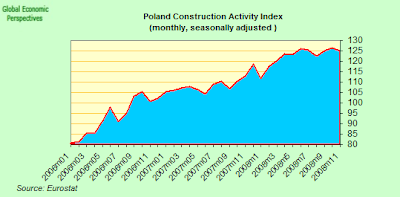
This slowdown in industrial output has also been accompanied by a levelling off in construction activity, which has been trending down in year on year terms since the late summer, but which even fell back month on month in November (by 1% over October) for the first time in many months.


In fact if we look at the actual index, rather than the year on year growth numbers, we will see that activity levels have been pretty stagnant for six months or so now.

After the sub-prime crisis banks became more restrictive in their lending policies. It is hard for real estate companies to get loans for their projects. Developers have to delay significant part of their pipeline projects, in most cases till an unspecified date in the future. The significantly tightened lending policies for households will worsen already weak demand for housing. Additionally, the already anemic investment activity should deteriorate further. It should be more and more difficult for real estate developers to sell their projects in the market and this source of money is also drying up.
Polish Equity Market Monitor - Citi Poland - January 2009


Retail sales levels have also flattened out recently, although they have continued to rise slightly in recent months. November 2008 retail sales grewth by just 2.7% year on year confirmed a fast slowdown in domestic consumption following 7.9% growth in October and 11.6% growth in September. While the Penkon consumer confidence indicator is now showing its lowest readings since 2005.

It is most likely that the good times for the retail industry are over. The drivers that fuelled sales and margins of Polish retail companies – rising consumer vdemand and strong Zloty, have disappeared and we do not expect them to return within foreseeable future.
Polish Equity Market Monitor - Citi Poland - January 2009


The Credit Noose Tightens

The core of the East Europe problem is that savings in many parts of the region are not sufficient to underpin growing loan books, thus the banks in the region - which are largely foreign owned - have needed to draw on their parent companies to bolster their balance sheets. When many of the parent banks entered into their own refinancing problems last year as the global financial crisis spiralled out of control, this channel of funding was transformed from being a source of strength into being a source of weakness.


In addition, at the start of last summer the Polish currency soared to record highs against the euro, and many Polish companies took out hedging contracts, effectively betting on further zloty appreciation. Now, as the currency has weakened and weakened, many of these very same companies have found themselves with substantial losses.

The Polish financial watchdog estimated last month that local banks may need to take out as much as $284 million in provisions to cover for client losses on currency options, which currently amount to 155 million zlotys ($49.33 million) among Warsaw-listed companies. And that figure could obviously grow if the zloty continues to weaken.

The zloty is currently at its lowest level since the end of 2004 - around 4.306 to the euro. Furthermore, it seems the government’s promise of accelerating the process of euro-adoption - which helped calm the zloty’s decline back in October - is failing to reassure markets. In fact most analysts seem to think that at this point having a 2012 entry target is as good ashaving no target at all.

Euro/PLN Cross - Please Click On Image For Better Viewing

Izabella Kaminska quotes the view of RBC capital, who basically argue that there is no way that the assigned date was ever going to be achievable:

On top of all this, there is no guarantee that Poland will meet the five Maastricht convergence criteria. Holding the PLN stable within the ERM2 bands for two years may prove to be a tall order while the budget deficit, which has been squeezed lower purely as a result of recent strong economic growth, will widen sharply as the economy slows, breeching (SIC) the 3%/GDP limit and disqualifying Poland from Euro entry.
As Izabella says there is a sort of catch-22 at work here: the only way Polish zloty can be saved from further weakening is Eurozone membership, but Eurozone membership becomes ever more distant as the zloty weakens due to the Maastricht criteria. Yet if we look at what has been happening to competitiveness in Poland in recent years (see REER comparison chart with Germany below), it is clear that due to the combined effect of wage inflation and a rising currency, there is some correction still to be made (not comparable with the Baltics or Hungary, but still) if Poland is recover its lost export prowess.


And here's another chart from Citi Poland showing how unit labour costs have steadily risen, and productivity has steadily fallen. The critical crossover point seems to have been somewhere towards the start of 2007. This pattern has been repeated in one CEE country after another, and really lies at the heart of the current economic crisis in the region.


In an attempt to boost liquidity in short-term Swiss franc money markets the National Bank of Poland has set up a currency swap agreement with its Swiss counterpart and the European Central Bank. The agreement will now last until at least the end of April. But while this agreement is obviously providing some relief it is clearly far from solving the problem.

“Today, the SNB, the ECB and the NBP are jointly announcing that they will continue these one-week euro/Swiss franc foreign-exchange swap operations at least until the end of April to support further improvements in the short-term Swiss france money markets,” according to the Polish central bank statement earlier this week.


UniCredit Under Threat?


At the heart of the forex lending (and exposure) in the East lie a small number of major banks whose head offices are to be found in large cities in the core countries of the EU (Western) old guard. Among these, indeed in pride of place here, comes Italy's Unicredit . (See my longer post on Unicredit here). Now it is true to say that Unicredit's Polish subsidiary - Bank Pekao - is relatively immune to the forex lending problem, since it refused to offer mortgages in foreign currencies, and its loan-to-deposit ratio at about 90 percent (compared with an average of about 110 percent for Polish banks generally) is fairly healthy. These features and a capital adequacy ratio of around 11 percent should offer Pekao a reasonable buffer going into the slowdown, but this is not the same thing as an absence of risk, since any serious deterioration in operating conditions inside Poland will affect PLN loan default rates as well as Fx ones, although evidently the banks with fx loan exposure are much worse positioned.

Concern about the position of the entire Unicredit group has been mounting steadily of late, as witness be the latest research report from Moody’s Market Implied Ratings group, which highlighting nagging doubts many observers have over the degree of the bank’s exposure to Central and Eastern Europe. The note, written by analyst Lisa Hintz, suggests UniCredit’s CDS-implied rating of A1 may well be “an overly optimistic signal of the bank’s level of credit risk”.

UniCredit largely avoided the proprietary trading and structured product problems suffered by the other large European banks. However, the financial problems arising from the economic downturn, such as imbalances, could cause deterioration in UniCredit’s loan portfolio, and we do not believe this is reflected in the trading levels of its credit default swaps.

UniCredit’s CDS-implied rating is A1, down three notches from a recent high of Aa1 and one notch below its senior unsecured rating of Aa3. We still see this as an overly optimistic signal of the bank’s level of credit risk, in that it doesn’t capture UniCredit’s comparatively thin level of capitalization and heavy exposure to Central and Eastern Europe. This exposure came after a rapid expansion which has left the bank with an unseasoned loan portfolio.
Loans to Central and Eastern European clients made up 13% of UniCredit’s assets at the end of 2007. These made up an even greater portion of its revenue—21% in the third quarter, and at the top of the list in both cases - see charts below - comes Poland. Fortunately no one is suggesting that the level of loan defaults might be anything like the 60% anticipated in Ukraine (or Russia??, both of which fortunately make up a much smaller part of their portfolio). This CEE activity means UniCredit leads its rivals Austria's Erste Group Bank and Raiffeisen International, France's Societe Generale, Belgium's KBC and Hungary's OTP in terms of both emerging European assets and exposure.


Indeed, UniCredit fell again in Milan today, after the Italian central bank warned yesterday that bank lending is declining and interbank liquidity is insufficient. UniCredit dropped as much 6.5 percent to 1.26 euros, the lowest intraday price since May 13, 1997, and traded at 1.29 euros as of 9:55 a.m. local time. UniCredit shares have now fallen 77 percent since January 2008. The Bank of Italy said yesterday there has been a “significant deterioration” in the general economic scenario and that “lending growth continues to decelerate” because of the high cost of funding for banks. “The situation just seems to keep spiraling in a negative way and if confidence in and among banks doesn’t return there’s no easy way out,” said Giulio Baresani Varini, head of investments at Banca MB SpA in Milan.

Meanwhile UniCredit Bank Austria AG, Austria’s biggest bank, plans to decide whether it will ask for Austrian state aid as part of the national bank bailout programme by the end of March. “We plan to make a decision by the end of the first quarter,” Chief Executive Officer Erich Hampel told journalists in Vienna today. Hampel said in December that Unicredit Bank Austria would need “about 2 billion euros” to increase its Tier 1 ratio, a measure of financial strength, to 9 percent from 7.6 percent at the end of Sept. 30.


But of course it isn't only Unicredit and its subsidiaries who are affected. BRE Bank SA fell to a three-month low on the Warsaw stock exchange this morning, leading Polish banks lower, as loan provisions and losses on derivatives cut into fourth-quarter earnings. The bank - which is a subsidiary of Commerzbank AG - slumped as much as 16.3 zloty, or 10 percent, to hit 146.9 zloty before recovering to 147 zloty at 10:32 a.m. in Warsaw, the lowest level since Oct. 27. The benchmark WIG20 Index was down 3.2 percent and has fallen 8 percent so far this year. The index slumped 48 percent last year, posting its biggest annual decline since its creation in 1994.

Despite 2008 being the worst year in a relatively short history of Polish equity market, with WIG20 down 48% we are not looking for a turnaround in 2009. The performance of the Polish market should still be strongly influenced by global markets which are likely to take some time to recover given the scale of a global macro slowdown not seen since 1945. The illness appears to be very serious and you simply need time to properly recover. We expect the WIG20 index to be down this year by some -10% to -15% (driven largely by expected weak performance of the banking sector).
Polish Equity Market Monitor - Citi Poland - January 2009

So Just What Are The Chances Of A Polish GDP Contraction In 2009?

Well the chances of a contraction of some order in Poland in 2009 are non negligible in my opinion. We are evidently not talking here of something of the order of the Baltics, Romania and Ukraine, or even of the order of Hungary, but still the extent of the slowdown in Poland (or the Czech Republic) should not be underestimated. Average corporate wages rose at their slowest pace in since November 2006 last month, suggesting economic growth is slowing more sharply in the wake of the global financial crisis than many seem to think.


The latest central bank forecast suggested that Poland’s economic growth will slow to 3.7 percent this year from about 5 percent in 2008, but this is very optimistic, and far from everyone agrees. Citi Poland come in with a much lower forecast, and in my opinion a much more reasonable one.

The Polish economy is not immune from global disruptions and an incoming and unavoidable slowdown is already visible. The question is when we will see the recovery. The answer is not easy as so far we have not yet seen the weak GDP numbers which are just around the corner. Looking back at the most recent slowdown during 2000-2003 period we observed 10 consecutive quarters GDP numbers below 2.5% and within that 5 sequential quarters when GDP growth came below 1%. However, this time the most recent 3Q08 GDP number came in at 4.8% so we see a lot of bad macro news ahead of us.

In 2009 we expect GDP growth slowing to 1.4%, driven predominately by deterioration in investment growth as banks started to be very restrictive in lending while corporates are looking for savings and are rather rapidly scaling down investment programs.
Polish Equity Market Monitor - Citi Poland - January 2009


I would go somewhat further. I think it is perfectly possible to see a recession in Poland at some point in 2009, not necessarily a strong one, but a recession just the same.

Monday, October 27, 2008

Poland To Consider Interbank Guarantees As The Forex Lending Crisis Deepens

Well, it's been a few weeks now since I posted on this blog, but I have a feeling that this situation may now be about to change. Pressure on Poland's economy is mounting as the clutches of the global credit crunch start to make their grasp and reach felt.


Stocks In Decline

Central European stocks declined for a fourth consecutive fourth day today, with indexes in Vienna and Budapest heading for record monthly drops, on mounting concern that the global financial crisis is going to have a severe impact on economic growth in the region and that the IMF sponsored rescue packages in Hungary and Ukraine won't avoid the worst of the damage. Concern is also mounting that the problem will affect the whole region, and hence the mounting pressure on Poland's rather stronger economy. If Poland falls, god help the rest of them.

Erste Group Bank AG slid to the lowest level in more than five years while Raiffeisen International Bank Holding AG, which operates in Russia and the Ukraine, plunged after mounting financial chaos forced Ukraine to seek help from the IMF.

Poland's WIG20 Index added 2.2 percent today following a 5.9% fall on Friday. The MSCI Barra Core Index (which is a measure of comparative equity values) is down 48% so far this month, and 61.24% over the last three months.


The Polish government has also announced today that Poland is considering guaranteeing interbank transactions, according to Deputy Prime Minister Waldemar Pawlak speaking on Polish public radio this (Monday) morning. Pawlak said that the government is examining the possibility of taking bank shares as collateral for the guarantees. Foreign investors in Polish banks have applied policies that are too strict in Poland, though credit problems have not affected Polish banks, Pawlak said .


According to the draft of a new law which is set to go before cabinet tomorrow (Tuesday) Poland's government will be empowered to guarantee commercial banks loans from the central bank and other lenders on the interbank markets. The government will also be able to lend cash and state securities to banks.


Poland's central bank injected 9.3 billion zlotys ($3.42 billion) of liquidity into the banking sector last week, in the form of 14-day repos. The decision was taken in order to try to ease strains on the Polish money market. The bank said it had accepted all bids worth 9.267 billion zlotys, at an average rate of 6.16 percent, 16 basis points above the main policy rate, with state bonds used as collateral. The minimum rate at which the central bank lent money to banks was 6.15 percent, while the maximum at 6.25 percent.

Poland's deputy prime minister also warned that local bank capital was at risk of capital being transferred to their financially-strapped foreign owners and urged the country's watchdog to stay vigilant.


"There is a risk that the capital will be transferred from Polish institutions to their parents," Waldemar Pawlak, who is also the economy minister and heads the governing coalition's junior party, was quoted as saying by PAP newswire.


The Financial Oversight Commission (KNF) has asked banks domiciled in Poland to report all transactions with their foreign owners daily. In a newspaper interview last week, the head of the KNF, Stanislaw Kluza, said the risk of capital transfers was very low, however, because Polish banks, with $284 billion in total assets, were too small to rescue large players in Europe and the United States. This is evidently true, but some of these bank are now under great pressure to avoid additional exposure in the east, and movement of funds can equally correspond to this strategy.

Foreign financial groups, among them Italy's UniCredit, the Dutch ING Groep, and KBC Group NV, Belgium's biggest bank and insurer by market value (all of whom are struggling with major problems at the present time), control two-thirds of the Polish banking sector after buying stakes in local lenders during the banking sector privatisation of the 1990s.


Polish lenders have been especially hurt in recent weeks by concerns over their ability to obtain foreign currency through interbank markets and worries about the fate of their foreign parents. Executives at some Polish banks have urged the government to consider introducing guarantees after the central bank's moves to boost liquidity on the interbank market, including foreign exchange swaps, failed to boost confidence between lenders. The financial watchdog KNF said on Saturday that Poland should think about measures to boost the Swiss franc positions of Polish banks, along with guarantees of interbank transactions or an eventual "institutionalisation" of the interbank market. But the regulator, the government and central bank insist Polish banks remain solvent and enjoy "over-liquidity."


Many of Poland's banks, like other lenders in the region, have been forced to introduce severe curbs on mortgages in Swiss francs due to pressure on their own liquidity and balance sheets. Such lending had become popular in Poland in recent months due to lower interest rates available from Switzerland and what was once favourable exchange rate.

Millennium BIGW.WA and PKO BP PKOB.WA, two of Poland's top home loan lenders, have gone so far as to announce that they were going to tighten rules for new mortgages due to the rising cost of money and fears that global financial nervousness may lead to much slower economic growth in Poland. Millennium Chief Executive Boguslaw Kott said last week that the group - which is Poland's third-biggest mortgage lender would ask for a 35 percent downpayment for popular Swiss francs-denominated home loans, a move which is likely to put a sharp brake on the growth of its mortgage portfolio.

PKO, Poland's largest mortgage lender, also confirmed it would ask new clients to put up 20 percent of the value of property when borrowing in francs. Millennium, which is controlled by Portugal's Millennium bcp, will now also require customers to cover 20 percent of investment when borrowing in Polish zlotys. Both banks had previously been offering mortgages equal to the entire value of the new home (100 LtV). Basically, what the hell these people thought they were doing by continuing to lend at 100% LtV after we have seen all that has happened in the US, and that is now happening in the UK and Spain is totally beyond "my ken", it really is.

Chief Executive Boguslaw Kott described the move as a precautionary one, and said it did not reflect any liquidity problems, adding that it was now more difficult to get Swiss francs on the interbank market. Marek Juras, head of research at BZ WBK brokerage is quoted as saying: "At times like these it is more important for banks to take care of their liquidity than drive their sales even higher." He estimated that for some lenders this would translate into a drop in new mortgages by between one-third and one-half.

The two market leaders join other smaller lenders, which in recent days moved to raise the bar for mortgage lending in foreign currencies as banks become more conservative and try to lure more cash on deposits by offering even higher yields. Mortgage adviser Expander said Getin's DomBank and Santander and GE Money had tightened their lending requirements. Many banks have also boosted margins on their mortgages in the past two weeks.

The Polish mortgage market has expanded rapidly since 2003, driven by economic growth and soaring wages, with annual growth exceeding 40 percent in the first half of this year. Large numbers of central and Eastern European housebuyers hold loans in foreign currencies, especially Swiss francs.

Most major Austrian banks, including UniCredit's Bank Austria, Erste Group Bank and cooperative Raiffeisen have now completely stopped lending to Polish domestic retail customers in foreign currencies.


After a meeting with economic advisers President Kaczynski advised Poles to keep faith in the zloty as the currency suffered further setbacks on the markets on Friday. Kaczynski recommended that loans should be taken in zlotys, not foreign currencies in order to avoid losing money on currency exchange.

"The depreciation of the zloty, which has its good sides for exports, boosts
mortgage loan installments for those who took them especially in the Swiss
franc. This may, however, be a lesson to us all to take loans in the Polish
currency. Considering low inflation, this gives the best results," Polish
President Lech Kaczynski told a press conference last Friday.

Seventy percent of the Polish banking sector is owned by foreign banks leading to concern that the impact of the general crisis in the banking sector will be felt in Poland. On Tuesday, Polish business Daily, Gazeta Prawna wrote, "The global financial crisis may cause large shifts in the Polish banking sector, AIG Bank Polska will soon be sold and there has been speculation that Fortis, Dominet, Citi Handlowy and even Bank Pekao may change hands."

Sell off speculation has surrounded the Italian owned Pekao bank over the last two weeks. It was subject to a 20 percent share price decrease in October prompting concerns that owner UniCredit may have been considering selling of all its Central and Eastern European assets. This has since failed to materialize but shows the current lack of faith surrounding the Polish banking sector.

Slawomir Skrzypek, president of The National Bank of Poland stated it had no intention of stepping in to help the zloty as it continues to weaken on the foreign currency market in a statement to reporters on Friday.


The sale of apartments in Poland has dropped by 70 percent in comparison to the same time last year, showing that the credit crunch is beginning to bite in Poland. The tightening of lending policies by banks has caused demand to fall and though prices are decreasing by 10 to 20 percent in some areas, buyers are looking for smaller flats, or withdrawing from the transaction altogether. The financial crisis has also influenced the situation of those clients who wanted to buy apartments without needing to get a mortgage, the number of which is declining due to losses on the stock market, says Gazeta Prawna.

Polish banks are to crack down on credit lending for housing loans after Poland’s financial regulator asked them to get tougher on lending practices. Millennium bank is one of the first high street banks to react and will now expect customers to cover 35% of the loan if they borrow in a foreign currency or 20% if borrowing in Polish zloty. The move is thought to be a precautionary one and not an indication of any liquidity problems, according to CEO Boguslaw Kott who told a news conference on Tuesday, “The decision practically blocks an increase of our mortgage portfolio.” He also told reporters that Swiss francs are harder to come by on the interbank market. Millennium Bank has been a dominant force in the Polish housing lending market with 80% of its mortgages being in Swiss Francs. This reflects a trend across Central and Eastern Europe where many house buyers have loans in either Swiss or other foreign currencies.


PKO BP, another major Polish mortgage lender, has joined Millennium in giving credits up to 80% of the value of the real estate. Fears that the Polish housing market could suffer similar repercussions to that of some western banks are as yet premature although the move does indicate a degree of uncertainty on behalf of the lending sector’s big hitters.


"We are extending between 35 and 60 million zlotys worth of mortgages each day, the vast majority of those in Swiss francs." Mariusz Grendowicz Head of BRE Bank BREP.WA "To fund our growth in mortgages, we were the only bank to the best of my knowledge that was using not swaps, which were the cheapest alternative, but actually taking a three- to four-year loan in Swiss francs to fund the book,"

The impact of the seize up in Swiss Franc housing loans is hard to guage at this point, although all the indications are that it will be serious. Foreign currency lending has not been such an important phenomenon in Poland as it has been in other CEE countries, but its weight has been growing in the last 18 months or so (see chart below).


The role of forex lending is clearly more important in housing loans than in general lending (see chart below).


One of the reasons for the recent uptick in Swiss Franc lending has been the monetary tightening cycle initiated by the central bank (see chart below), which made the cheaper interest rates available in CHF more attractive even though there was an evident currency risk involved.


If we look at the next chart the year on year rate of increase in the forex loans (the Polish central bank don't distinguish in their data between CHF and Euro, but all the anecdotal evidence cited above points to a significant role for the CHF, and especially given the role of Austrian banks were this type of lending has been commonplace.


The big problem is really that the CHF is a "carry trade" currency, and carry currencies have a strong tendency to shoot up in value as risk sentiment retreats, quite simply because people all try to liquidate their positions at the same time. Hence carry currencies have a kind of "pro-cyclical" role, adding to the boom during the good times, and making the bad times even worse. Which would be one very good reason why if you really do want an fx mortgage, using a currency other than a carry one would be a good idea. Obviously those who have euro denominated mortgages - while not being immune from the present problems (see the Baltics) - are less exposed, since the movements in the relative value of the euro tend to be in the opposite direction to those of the CHF and the Japanese yen.


Where Does All This Leave Us?


Well obviously Polish GDP growth is now set to slow quite dramatically. At this point just how dramatically is hard to see. Credit Suisse Group recently cut its forecast for Polish economic growth next year, predicting that the global financial crisis will hurt consumption and investment.


Credit Suisse said Poland's gross domestic product will rise by less than 4 percent in 2009, compared with the 4.4 percent rate it had previously forecast, according to a note to clients last week. The revision, amid rising aversion to risk in emerging markets, pushed the zloty to a two-year low against the euro. I think, basically, even Credit Suisse are being over optimistic at this point, although I think we need to see some real economy data before putting numbers on just how over-optimistic they may be.

Poland's `` private consumption and investment should fall further than we had anticipated due to our expectations of an increasingly restrictive credit environment in 2009,'' Jacqueline Madu, an emerging-markets research analyst at Credit Suisse in London, wrote in the note.
.

One of the first areas where we should expect this crunch to be felt is in construction activity itself. There is no doubt that Poland has been "enjoying" the fruits of a construction boom since the second half of 2006. It seems to have come in two "waves" if we look at the chart below, with the first wave being much stronger than the second one.


If we actually look at the level of the seasonally adjusted index, then the steep increases in the levels of construction output become apparent. We should also notice how since about April the level has stopped rising, and this seems to suggest that the expansion in the industry had been slowing even before the latest credit shock. Be ready for this to be followed by a sharp slowdown in the months to come.

If we look at the chart for year on year industrial activity, then it is clear that the expansion in output has been fading for months now - not a good sign, not good at all, since it means that there is little underlying stability to resist the knock. The thing is running out of energy.


This becomes evn clearer when we look at the seasonally adjusted index, since it is pretty clear to see that industrial output went into decline at the end of last year, killed off in part by a high zloty, and in part by excess internal wage and cost push inflation.


Wednesday, August 27, 2008

Poland's Central Bank Leaves Rate Unchanged

Poland's central bank left its benchmark interest rate unchanged for a second month as it assesses whether eight increases in the past 16 months have been enough to keep inflation within the limits it requires. The Narodowy Bank Polski kept its seven-day reference rate unchanged at 6 percent this week, although it did stress that further monetary tightening may be needed to bring inflation down to the target.


Slowing industrial output and retail sales indicate economic growth is itself slowing, and the bank takes the view that this, and the recent decline in global oil prices should reduce pressure on inflation after consumer prices rose at a rate of 4.8 percent in July, the highest level in eight years.

The bank said today that recent data showed the economy was gradually slowing while wage growth still remained strong. The central bank expect the inflation rate to stay above their 1.5-3.5 percent target range in the coming months, and indeed they have now been struggling for some 10 months get the rate down to their 2.5 percent target midpoint.

Monday, August 18, 2008

Polish Wages Continue To Rise Strongly In July

Polish average corporate wages rose more than 10 percent for a seventh consecutive month in July, suggesting that interest rates will be raised in the future. Wages rose an annual 11.6 percent to 3,229 zloty ($1,425), compared with a 12 percent rate in June, according to the Central Statistical Office today. Wage growth has been the main gauge of inflationary pressure by the Narodowy Bank Polski, which has so sar boosted its benchmark rate eight times since April last year, to the current rate of 6 percent.


Employment was up 4.7 percent from a year in July, and rose 0.2 percent on the month. Unemployment is thought to have fallen to 9.4% in July, down from June's 9.6%. Poland's inflation rate rose in July close to a seven-year high as accelerating wage growth spurred consumer demand. The annual rate rose for a third consecutive month to 4.8 percent from 4.6 percent in June.


The inflation rate may rise in August to as high as 5.1 percent, according to the central bank forecast.